
From the fields to the classroom
Children's journeys out of child labour in Lebanon
For many girls and boys in rural Lebanon, work in the fields has replaced education and play. Through safe spaces, psychosocial support and assistance to families, the ILO and its partners are helping children build a future beyond child labour.

These efforts contribute to the ILO's long-term goal of eliminating child labour in all its forms.
Compiled between March and May 2026, this photo story documents how the ILO and its partners, Plan International and the Rene Moawad Foundation along with UNICEF, are providing support to children and their families amid economic hardship, loss of livelihoods, conflict and displacement in Lebanon.
Child labour has long been a widespread concern across Lebanon, affecting both Lebanese and refugee children.

In Lebanon's fields, conflict and poverty push more children into work.
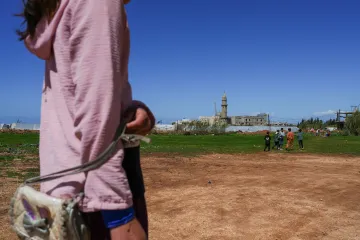
In eastern Bekaa Valley and northern Akkar district - both key agricultural areas - reliance on seasonal agricultural work often push children into child labour.

Children engaged in agricultural child labour are often exposed to hazardous conditions,
such as operating dangerous tools and machinery and exposure to chemicals, environmental stressors and long hours planting, harvesting and sorting produce which could harm their health, safety, and morals.
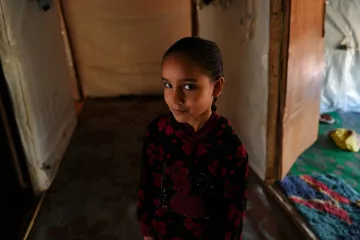
In Lebanon's Akkar district, many Syrian agricultural workers live in tents erected in the fields where they work alongside their children. The area has also recently become home to newly displaced Lebanese families and Syrian refugees fleeing conflict elsewhere in the country.
Some children work seasonally and are able to attend school outside of harvest periods, while others work throughout the year because their families depend on their income to survive.

The escalation of hostilities between Hezbollah and the Israeli military in 2026 inflicted immense harm on civilians in Lebanon, causing thousands of casualties, disrupting basic services and driving hundreds of thousands from their homes.
Mass displacement, loss of livelihoods and disrupted economic activity have pushed families deeper into poverty, vulnerability and economic and food insecurity. These factors have increased the incidence and risk of child labour and early school dropout, which, in turn, have severely impacted children’s well-being.
The destruction in the village of Nabi Chit in March 2026 reflects the wider disruption facing communities across the Bekaa Valley, where many Lebanese and Syrian families depend on agricultural work for a living. As hostilities forced families to flee and reduced agricultural activity, already fragile livelihoods came under further pressure.
Ali Mohammad Al-Taqash, a father of three from the village of Talya in the Bekaa Valley, says years of economic crisis, compounded by recent hostilities, have made it increasingly difficult to support his family.
"I work in agriculture, but the income is never enough. Before the crisis worsened, I tried to keep my children in school, even paying for private education, because I believe children belong in classrooms, not in the fields. But when the economic situation collapsed, I had no choice but to send them to work with me so we could survive," he said.
"We evacuated several times as missiles struck nearby, and we are on constant alert,” he said in April. “Agricultural work has become dangerous. During the worst periods, my children were terrified by the bombings and sonic booms."


"I always feel ashamed that poverty has forced us into this situation, but every day there are expenses - food, bread, transport, medicine - and there is no one to help us."
Ali Mohammad Al-Taqash
Supporting children and their families
Ali's children now receive support and have begun returning to school.
The ILO aims to eradicate child labour in all its forms. Through the Netherlands-funded PROSPECTS partnership, the ILO and its partners are adopting a phased approach: supporting children already engaged in child labour, while working with families to reduce reliance on children's work and encouraging school enrolment.
The project has established vital support systems through the complementary roles of UNICEF and ILO. Activities were delivered mainly through UNICEF-run Makani (“My Space”) centres in the Bekaa Valley and the Akkar District, which provide safe and inclusive spaces and integrated services for children and families. These centers promote children’s learning and well-being, while strengthening the resilience of families and communities.

Building on UNICEF’s Makani integrated package of services, the ILO complements this approach with specialized technical expertise and tailored programming to address child labour.
Using participatory methodologies and ILO tools designed to address child labour in agriculture, facilitators help children better understand their rights, protect themselves from harm at work and envision a future beyond child labour.
Parents and caregivers also attend sessions where they discuss their own challenges and learn how to reduce reliance on child labour and support their children’s return to school.


A safe place to grow
Safaa Samir Al Khaled, a Syrian mother living in Lebanon, works with her 12-year-old daughter Roya, in a greenhouse in Akkar.
"I work in agriculture to support my family," she says. "Like many families around us, my daughter Roya also works with me in the fields. Before participating in the ILO programme, we did not fully understand the risks of child labour. Roya spent long hours helping with agricultural tasks, sometimes working four hours a day or more."
Safaa says that the sessions changed the family's approach to child labour, helping them better understand its risks and the importance of education. "Roya stopped working and returned to school, and her daily life is now much more stable and organized."
Safaa’s daughter Roya now attends school in the afternoon and has time to study, rest and spend time with other children. Safaa says the project’s activities have also helped strengthen Roya's confidence and emotional wellbeing.
"At the beginning, she was extremely shy and fearful. During the first sessions, she could barely speak and would tremble from anxiety. Now she talks freely, makes friends and feels safe at the centre. I feel my daughter has a better chance for the future now, with education and childhood back in her life."

Between the classroom and the fields
Ahmad Abdel Rahim, a 14-year-old Syrian boy, lives in northern Lebanon with his parents and six siblings. He balances school with agricultural work to help support his family.
"I go to school, and Arabic is my favourite subject. I enjoy learning, and I dream of becoming an engineer one day," he says.
Ahmad works around five hours a day, depending on what work is available, filling bags with produce, removing weeds and preparing crops for export. He earns less than the equivalent of one US dollar an hour.
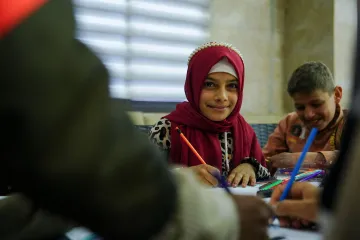
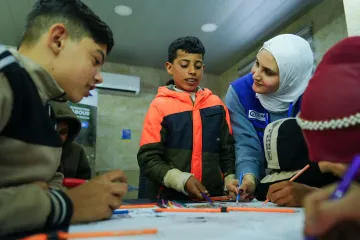
At centre in Akkar, Ahmad receives psychosocial support and takes part in educational sessions. "We draw, play and learn new things, especially about nutrition and health. I enjoy spending time in a safe place where we can talk and take part in activities."
My dream is to continue attending classes and become a nurse
Yara Abdel Nasser Al Mohammad, a 14-year-old Syrian girl living in Lebanon, attends sessions at the local centre in Tal Maayan. "I learn useful things, especially about the rights children should have from birth until the age of 18. I live in northern Lebanon with my parents, my four sisters, and my three brothers. We live in a tent," she says.
Yara works in agriculture for around four hours every day. "I weed, water crops, and work with carrots, tomatoes, and other produce. The work is very tiring and exhausting," she says.
"Sometimes I also play or spend time talking with my mother. I have a best friend in the camp, and she also works in agriculture. My dream is to continue attending classes like this one and become a nurse when I grow up."
"If we do not work, we do not eat"
Before the escalation of hostilities, 15-year-old Hussein Jamal balanced school with helping his family grow onions and garlic on rented land. Today, he works full time.
"Because of the war and the difficult economic situation, I had to leave school to help support my family," he says.
Hussein explained that his father has heart problems, and his mother sometimes joins him in the fields. "If we don't work, we don't eat," he said.
At the Makani centre in the Bekaa Valley, Hussein has learned about safety in agricultural work and received support. "Most importantly, I made friends and found support during a very difficult time."


Hope takes root
Hanan Ibrahim Al Alawi is a Syrian mother living in Lebanon with her two children, a seven year-old boy, Omar, and a nine year-old girl, Ritaj, after the death of her husband.
"To survive, my daughter and I work in agriculture, doing seasonal tasks such as weeding parsley fields. The pay is very low, and work is often irregular, making life extremely difficult," she says. "Because of our financial situation, my children are currently not attending school, as we work simply to cover our daily needs."
Hanan says the psychosocial sessions offered at the centre provide the family with a safe space to speak openly about their difficulties and worries.
"Seeing my daughter smile, even briefly, gives me strength to continue despite everything we are going through." She adds.
A comprehensive approach
The project addresses gender-related risks by tailoring support to the different types of work, hazards and pressures faced by boys and girls. Boys are generally involved in more physically demanding labour, such as carrying heavy loads and performing strenuous field work, while girls are more often engaged in harvesting, collecting and sorting produce.
Through awareness raising, psychosocial support and caregiver sessions, the project helps families prevent and eliminate child labour, supports children’s return to education or vocational training, and promotes safe and decent work for adolescents above the minimum working age. It also provides entrepreneurship training and seed funding to help parents start small businesses, reducing economic pressures that can drive child labour.

Next steps
ILO’s approach combines support to children and families with efforts to strengthen institutions and the systems needed to prevent and eliminate child labour.
This includes work with the Ministry of Labour and the National Child Labour Steering Committee, the revision of the National Action Plan on the Worst Forms of Child Labour, and local coordination with the Ministry of Labour, UNICEF, the Child Protection sector and Plan International in Tripoli, Akkar and Bekaa/Baalbek-Hermel.
At the household and community level, while UNICEF is providing the established community platform and integrated service delivery model through Makani, the ILO is helping families identify risks, access services and build pathways that can lead children back to learning and safer futures.
The ILO, under the PROSPECTS partnership, is set to extend support to reach displaced children engaged in child labour and their families in other parts of the country, including the capital Beirut.
About the PROSPECTS Partnership
The support provided through this project is part of the ILO’s wider effort under the Netherland-funded PROSPECTS partnership in Lebanon, which brings together ILO, IFC, UNHCR, UNICEF, and the World Bank. The PROSPECTS partnership aims to strengthen the resilience of crisis-affected labour markets and create more sustainable livelihoods for both Lebanese host communities and Syrian refugees.
ILO’s approach links efforts to prevent and eliminate child labour with education, economic inclusion and social protection, recognizing that child labour cannot be addressed through one intervention alone.
Ending child labour requires sustained action to address its root causes: poverty, lack of decent work for adults, limited access to education, weak social protection and the growing pressures created by conflict and displacement. In Lebanon’s agricultural communities, this means supporting children today while working with families, communities and partners to ensure that children are no longer pushed into work at the expense of their health, safety, education and childhood.
The ILO defines child labour as work that is mentally, physically, socially or morally dangerous and harmful to children, and/or that interferes with children's schooling.